Happy Canyon Interchange
Project Overview
Improvements are coming to the Happy Canyon Road and Interstate 25 (I-25) interchange in Castle Pines. To improve safety and address rising traffic volumes, the City of Castle Pines, in partnership with Douglas County and the Colorado Department of Transportation (CDOT), have selected contractor Kraemer North America to reconstruct the Happy Canyon interchange. Reconstruction of the interchange will improve traffic operations, connectivity, and regional mobility, as well as support local community growth.
Improvements include replacing the existing bridge, constructing an additional bridge structure north of the existing bridge, rebuilding the I-25 on- and off-ramps and overall signal and intersection improvements. Construction is anticipated to begin in fall 2026 and be completed in mid-2028. The project will also allow the connection from the interchange to The Canyons via Canyonside Boulevard. This connection will be constructed by The Canyons developer and is expected to open following the completion of the interchange improvements.
To reduce impacts to the traveling public, the majority of interchange reconstruction will take place outside of the roadway. Crews will construct the new bridge over I-25 in two phases, to allow traffic to be maintained on Happy Canyon Road while bridge construction takes place. Crews will also utilize temporary lane realignments on I-25 and intermittent ramp closures. To receive updates about future impacts, join our email list.
A pre-construction open house meeting took place on June 4. If you were unable to attend the meeting, check on the materials that were available.
Construction Schedule
- Anticipated Start: Fall 2026 (more specific information will be shared as it becomes available)
- The project team is waiting for final approvals from the Colorado Department of Transportation. The project start and end dates will be updated as soon as more information is available.
- Anticipated Completion: Mid-2028
Project Phasing
- Phase 1: Construct a new bridge structure over I-25 north of the existing bridge
- I-25 lanes will be narrowed and temporarily shifted
- Happy Canyon Road traffic will continue to use the existing bridge
- Intermittent ramp closures of the northbound I-25 on-ramp and the southbound I-25 off-ramp
- Nighttime I-25 closures for girder installation
- Phase 2: Demolition of the existing bridge and construction of the southern bridge structure
- Happy Canyon Road traffic moved onto the newly built northern bridge for access to/from and over I-25
- Nighttime I-25 closures for bridge demolition and girder installation
- Intermittent ramp closures of the southbound I-25 on-ramp and the northbound I-25 off-ramp
- Phase 3: Tie in new ramps to I-25 and bridge structures to the east and west sides of I-25
- I-25 lanes will be narrowed and temporarily shifted
- Intermittent ramp closures
- Various lane closures on I-25 and Happy Canyon Road for finishing work
Diverging Diamond Interchange Design
The preferred alternative shown below, referred to as a Diverging Diamond Interchange (DDI), is being evaluated by a joint effort between the City of Castle Pines, Douglas County, CDOT, and the Federal Highway Administration (FHWA).
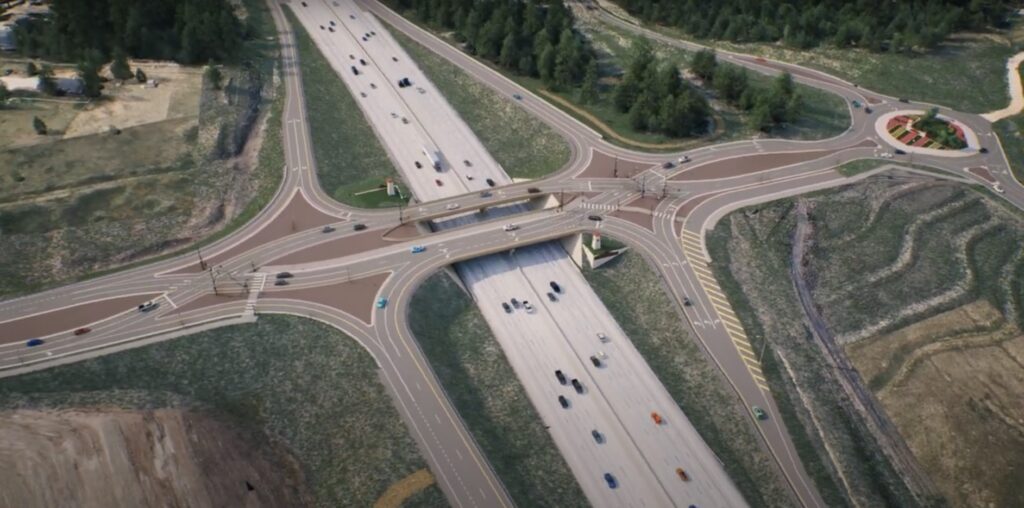
DDIs are an innovative approach to traffic design, offering improvements in safety and efficiency. These interchanges excel in managing heavy directional traffic, ensuring smoother flow and reducing congestion in high-volume areas. Left-turn movements are typically the most risky and least safe movements through an interchange. With a DDI, CDOT reports that these dangerous T-bone accidents are eliminated by removing the typical left turn movement.
Benefits of a diverging diamond
- Reduces delays by using a two-phase signal rather than a traditional four- or six-phase signal
- Requires fewer lanes but can handle more traffic capacity
- Reduces conflict points at intersections
- Improves pedestrian crossing safety with easier access to medians
- Increases left turn capacity
- Eliminates wrong-way entry to ramps
- Costs less than a typical free-flow interchange utilizing single-directional flyover ramps
How to drive a diverging diamond interchange
You can view a variety of video renderings on the City's YouTube Channel to watch alternate views of the DDI in operation and learn how to drive through the new interchange design.
Watch this video from the Colorado Department of Transportation for more information on driving through a DDI.
Funding
The Happy Canyon Interchange Project was initially identified in the Denver Regional Council of Government's (DRCOG) long-range 2050 Metro Vision Plan, and the City was allocated pre-construction funding through the DRCOG Transportation Improvement Program (TIP) project selection process. The DRCOG allocated Federal Funds (Surface Transportation Block Grant) were matched with City and County funds to advance the National Environmental Policy Act process, design and other pre-construction tasks.
Construction costs are anticipated to be $42 million. The City of Castle Pines and the surrounding developments' contributions total $14.5 million. Douglas County contributed $16.5 million from its current Transportation Capital Improvement Program 5-Year list of priority projects. Lastly, the City was able to procure $11 million from CDOT to replace the existing Happy Canyon bridge over I-25 as part of the overall interchange improvement project.
Background and History
In 2015, Douglas County initiated the Happy Canyon Road and I-25 Improvement project to identify long-term interchange improvements, including 2030 and 2040 traffic projections, alternative analysis, and the development of conceptual design plans for various interchange alternatives. Revised traffic modeling was necessary to update the Castle Pines Parkway & Happy Canyon Road Final System Level Study (Aug 2009).
In 2022, the City of Castle Pines elected to move forward with managing the Happy Canyon Interchange project and to advance improvements to the connection from I-25 to both Lagae and Happy Canyon roads. This connection and roundabout were completed in summer 2024. The City worked closely with the County, CDOT, and FHWA to finalize the System Level Study that evaluated the existing and future traffic operations utilizing 2050 traffic projections.
Using CDOT's Policy Directive 1601, Interchange Approval Process, several strategies were developed to expand mobility options and help reduce single-occupant vehicle trips. This is accomplished by promoting and implementing strategies, programs, and alternative modes of travel, including carpooling, walking, teleworking, and biking.
Utilizing 2050 traffic projections, the City and its consultants identified four alternatives (design options) to improve the interchange. The four interchange alternatives evaluated include:
- Tight Diamond with Traffic Signals at the I-25 Ramps
- Tight Diamond with Roundabouts at the I-25 Ramps
- Single Point Urban Interchange (SPUI)
- Diverging Diamond with Traffic Signals at the I-25 Ramps (DDI)
The DDI was selected as the preferred alternative to move forward through the National Environmental Policy Act clearance process and into preliminary and final design.
The Tight Diamond Interchange options studied cannot provide acceptable operations for the forecasted 2050 traffic volumes, meaning that this option would not provide traffic alleviation. Although the SPUI can operate with the 2050 volumes, it is estimated to cost $10 million more than the DDI. It was determined that the DDI alternative will better accommodate the 2050 traffic projections than the Tight Diamond with Roundabouts at the I-25 Ramps alternative, which was previously determined to adequately handle the 2040 traffic projections.
Approval of the surrounding developments has been contingent on interchange improvements and incorporates connections with the surrounding regional road network, such as Crowfoot Valley Road.
Happy Canyon Interchange Resource Documents
- Pre-Construction Open House Information Boards
- Pre-Construction Open House Handout
- I-25 Planning and Environmental Linkages Study
- Proposed Happy Canyon and I-25 Interchange Improvements Update - PowerPoint Presentation to Happy Canyon HOA (May 2022)
- Resources from March 2025 Open House
- I-25 and Happy Canyon Road Interchange Alternative Analysis
Stay informed on the progress of this project:
- Sign up for The Source community e-newsletter.
- For answers to questions, email or call the project team: HCInterchange@castlepinesco.gov or call 303-705-0200.
- Facebook updates
- X (formerly Twitter) updates
- Nextdoor updates