Crowsnest Annexation Petition
March 24 Update: The applicant, VT Crowfoot Valley Landco, LLC, has withdrawn its petition for annexation of the Crowsnest property
City Council Request to Develop Annexation Policy Development
During the March 24 City Council meeting, Council approved Resolution 26-23 to direct staff to begin developing an Annexation Policy for any future annexation applications. The intent of this policy is to establish criteria, informed by resident input, to guide future discussions on annexation applications submitted by property owners.
The City of Castle Pines has received an updated petition from VT Crowfoot Valley Landco, LLC to annex a group of properties, known as Crowsnest, an approximately 795-acre property adjacent to and including portions of Crowfoot Valley Road east of the Canyons. The property is currently located in unincorporated Douglas County. See the map for an overview of the boundary for the land included in the petition.
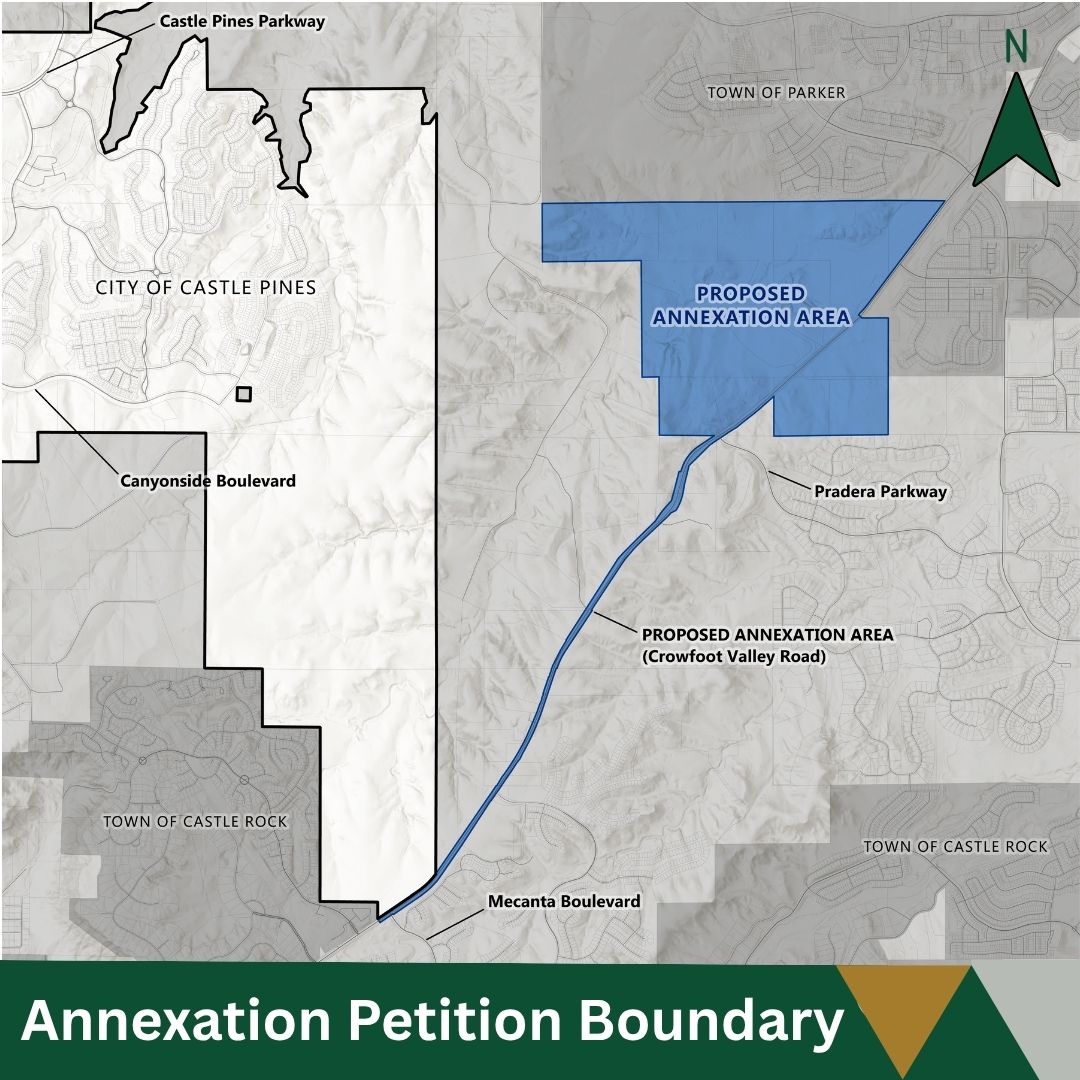 The timeline for City Council consideration of an annexation is primarily determined by state law and requires a public hearing and the passage of an ordinance. Once a property is deemed eligible for annexation by meeting certain criteria under state law, the City Council will evaluate whether the annexation is beneficial to the City in making a final decision. If the property is annexed, the property must be zoned within 90 days.
Annexation is the process by which a municipality may incorporate additional land within its jurisdictional boundaries. The most common method of annexation is a petition from the landowner(s), which usually involves a negotiated agreement that sets forth the terms of annexation and obligations of the petitioning property owners and the municipality.
For more information, view the annexation application timeline below. If you have questions, contact the City's Community Development Director Donna Ferguson at Donna.Ferguson@CastlePinesCO.gov.
Crowsnest Annexation Petition Overview:
- Crowsnest Property - The properties included in the Crowsnest annexation application are all privately owned, primarily zoned agriculture, and there is no open space land designation.
- Revenues/Expenses - The City will not share any public revenues back with the developer. View the Fiscal Impact Analysis Overview for more information about anticipated revenues and expenses.
- Public Infrastructure - All infrastructure for the Crowsnest development, including, but not limited to, Lemon Gulch, roads, including Crowfoot Valley Road widening, water, sewer, drainage, and parks design and construction, would be covered 100 percent by the developer. No public funds would be expended for the capital construction of any public improvement.
- Canyonside Boulevard Connection to Crowfoot Valley Road - Should traffic studies show that the Canyonside Boulevard connection to Crowfoot Valley Road needs to be made to mitigate traffic impacts north or south on Crowfoot Valley Road, the Crowsnest developer will be responsible for making that connection, including cost, in compliance with the City's transportation design standards.
- Crowfoot Valley Road - Crowfoot is expected to be expanded from two lanes to four lanes in the future. This expansion is anticipated regardless of the potential Crowsnest development. The widening will involve Castle Pines (if the annexation occurs), the Town of Parker, Douglas County, and the Town of Castle Rock. If the annexation is approved, the developer will be responsible for fuding the prorated amount of the expansion to four lanes based on the traffic volumes.
- Open Space - Dedicated open space in the Crowsnest property is expected to reflect Castle Pines' existing average percentage of open space to maintain a similar look and feel with the rest of the community.
- Units/Density - The overall unit count and density is anticipated to be similar to the current Castle Pines' averages to help maintain a similar look and feel of Castle Pines.
- Wildlife - Wildlife studies were completed and reviewed by the City's wildlife consultants and Colorado Parks and Wildlife. The studies were found to be complete, and no constraints on the proposed annexation were identified by either entity.
- Fire Protection - The property is within the South Metro Fire District service area and will be served via the district's property tax collection. Land will be dedicated should, in the future, a new fire station needs to be constructed to maintain regional service levels.
- Law Enforcement - Law enforcement would be provided by the City of Castle Pines through the Douglas County Sheriff's Office pursuant to the existing Intergovernmental Agreement and funded through the City's existing 4.5 mills property tax.
- Schools - The Developer will be required to provide land dedication or a cash-in-leu to support future school capital needs. The property is entirely within the Douglas County School District and would pay the same property taxes as all Douglas County property owners to support the school system.
- Water and Sewer - Prior to any development, the developer will be required to be included into the Parker Water/Sanitation District so the City is assured that the development will have the necessary water and sewer services.
- Future City Responsibilities - Over time, public infrastructure would be dedicated to the City, and the City would be responsible for maintaining parks, open space, trails, drainage, and roads. The Fiscal analysis (provided in the text above) shows that there are sufficient funds to maintain the additional infrastructure.
Annexation Petition Timeline:
The timeline below is tentative and subject to change.
- January 13: City Council approved a Substantial Compliance Resolution.
- The purpose of the meeting was to consider a resolution on whether the City Council found the annexation petition in substantial compliance with state law (the requirements of the Municipal Annexation Act of 1965) and to set the Eligibility Hearing date for the proposed annexation. This is the first step in the annexation process; it does not mean that the City Council supports or opposes the policy question of whether the property should be annexed. It determines whether the petition complies with state law.
- February 24: City Council approved a resolution finding the property eligible for annexation.
- The purpose of this meeting was to determine if the property was eligible for annexation. This is the second step in the annexation process; it does not mean that the City Council supports or opposes the policy question of whether the property should be annexed. It determines whether the property is eligible for annexation.
- March 19: Applicant withdraws annexation petition. Previously scheduled Planning Commission and City Council Public hearings will be vacated (canceled.)
Resources:
- Annexation Petition
- Title Commitment Maps
- Landowner Authorization Letters
- Zoning Map
- Water Supply Evidence
- Presubmittal Comments
- Presubmittal Comment Responses
- Fiscal Impact Analysis - Prepared by Petitioner
- Fiscal Impact Analysis Review - Prepared by City of Castle Pines Consultant
- Fiscal Impact Analysis Overview
- Annexation Impact Report
The City received a second submittal from the applicant on February 9. The documents the applicant updated are listed below. Old versions of the same document have been removed for clarity.
- Phase 1 Environmental Site Assessment
- Natural Resources Assessment
- Planned Development Closure Report
The City received a third submittal from the applicant with updated documents. The documents the applicant updated are listed below and are current as of March 4, 2026. Old versions of the same document have been removed for clarity.
The City received a fourth submittal from the applicant with updated documents. The documents the applicant updated are listed below and are current as of March 10, 2026. Old versions of the same document have been removed for clarity.
Frequently Asked Questions
What's the annexation process?
All annexation proposals must follow a State-mandated process, which includes public hearings for each step and requires City Council to make three specific decisions:
- Substantial Compliance: Does the annexation petition comply with State law?
- Eligibility: Is the property eligible to be annexed in accordance with State law?
- Annexation: Should the property be annexed?
Substantial compliance and eligibility are determined at City Council meetings and are procedural in nature. If City Council determines the annexation petition complies with state requirements and the land is eligible to be considered for annexation, a public hearing would take place to determine if the land should be annexed. This hearing will include an opportunity for public comment.
Petitions for annexation are evaluated by City staff
To help City Council's decision-making process, staff reviews the proposed annexation and studies the potential impacts on the City, including fiscal impacts and impacts to infrastructure and overall levels of service. The goal is to determine whether the annexation would benefit the City.
How are annexations zoned?
If an annexation is approved, the property must be zoned for land use within 90 days. Zoning includes a public hearing during a City Council meeting and includes an opportunity for public comment.
Why is the City considering an annexation of property?
Petitions for annexation are submitted to the City by private landowner(s). The City is required to review proposed annexations and, if it meets the requirements outlined by State law, consider a proposed annexation for inclusion in its jurisdictional boundaries. City Council will evaluate whether the annexation is beneficial to the City in making a final decision.