Land Development Process
Steps to constructing a new development in Castle Pines
Before any new residential or commercial development in Castle Pines can begin construction, it must go through a series of steps and reviews to ensure it meets City standards and aligns with the City's guiding documents. If a project is planned in the near future, chances are, City staff is already reviewing it. Everything from new roads and parks to residential subdivisions and commercial areas all get reviewed by the Community Development team before it's approved for construction. The team makes sure all developments meet City standards for design, safety, and quality of life.
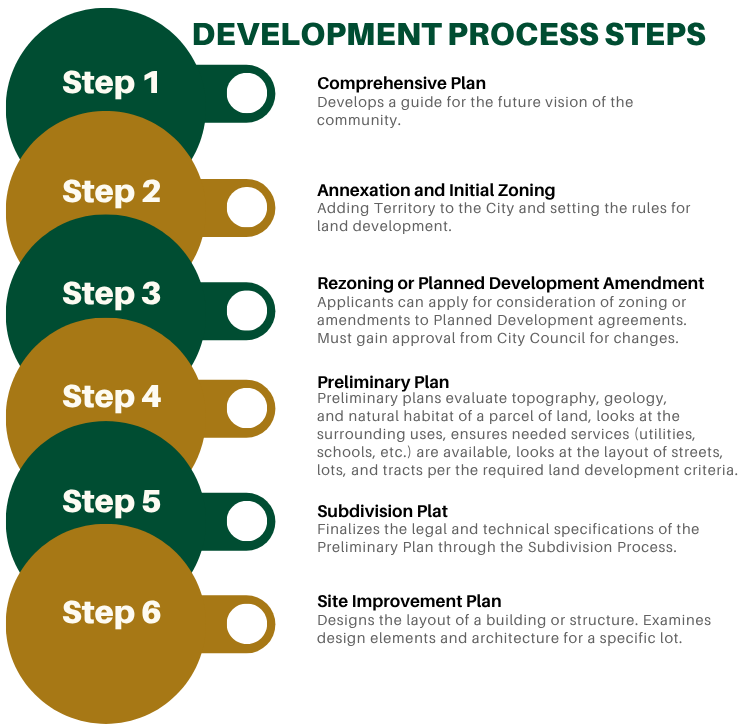 Generally, there are six steps from start to finish in the development process. Some of these steps, such as developing the City's Comprehensive Plan to guide the community's vision, start very early and include high-level ideas. Others, like site improvement plans, involve examining very small details such as the type of building materials and landscaping. Learn more about the different applications on the Types of Land Development Applications webpage. Visit the Land Development Project Applications webpage to view applications currently under review.
Creating a consistent development process allows private land owners to construct residential or commercial buildings on their land while ensuring the new development meets established City standards. The process balances private property owner rights with the needs and desires of the community.
View the development steps and frequently asked questions below for more details about the development process, including information about the public engagement process. If you have questions about development in Castle Pines, contact Community Development Director Donna Ferguson at donna.ferguson@castlepinesco.gov.
Development Process Steps
Comprehensive Plan
The City of Castle Pines Comprehensive Plan represents another step in the City’s ongoing efforts to build and maintain a balanced, unified, and sustainable community. The Plan is designed as a living and evolving document that captures the community’s shared values and can adapt to reflect changing City Council priorities, new technologies, emerging trends, and regional opportunities. Generally, the planning horizon looks out 20 years and is a resource for community leaders to guide growth and development. It sets forth the community’s vision for the future, identifies goals and objectives to help guide development decisions, and proposes implementation strategies to bridge the gap between policy and development.
The Plan includes all land located within the city boundaries, which encompasses 9.5 square miles. The Plan covers issues associated with land development within the community, including economic development, housing, transportation, parks and recreation, land use, and growth management.
When land development applications are submitted, they are reviewed to ensure they align with the City's established vision as documented in the Comprehensive Plan.
Public Input: During each Comprehensive Plan update, extensive public engagement is conducted to ensure that the final adopted plan meets the vision of Castle Pines residents.
Annexation and Initial Zoning
If the owner of property in unincorporated Douglas County wants to develop it within the City of Castle Pines, they must request annexation. Annexation changes the City's boundary to include additional property. At the time of annexation, the land is also zoned (residential, commercial, mixed-use, etc.) for allowed uses. The zoning is what determines what type of uses are allowed on specific parts of land.
Rezoning or Planned Development Amendment
A property's zoning determines its allowed uses, the density or size of the development allowed on it, and the design standards that must be met for its development. In Castle Pines, properties are either straight zoned — with designations like residential — or zoned as a planned development (PD).
Property newly annexed into the City must establish zoning at that time, even if it is not developed until decades later. If a development idea includes uses not allowed in its current zoning, the owner would need to rezone it — this is called a planned development amendment (PD amendment) in areas with planned development plans. Rezoning or PD amendments require approval by the City Council.
PD Amendment Steps
- Presubmittal meeting with City staff
- Submittal to City staff for review by planners, engineers, and legal until all standards have been addressed
- Referral to partner agencies and known HOAs
- One public hearing before the Planning Commission
- Two public hearings before the City Council
Preliminary Plan
Preliminary plans evaluate the topography, geology, and natural habitat of a parcel of land, consider the surrounding uses, ensure needed services (utilities, schools, etc.) are available, and examine the layout of streets, lots, and tracts per the required land development criteria. City staff review this information to ensure it conforms to the required standards.
Preliminary Plan Steps
- Presubmittal meeting with City staff
- Submittal to City staff for review by planners, engineers, and legal until all standards have been addressed
- Referral to partner agencies and known HOAs
- One public hearing before the Planning Commission
- Two public hearings before the City Council
Subdivision Plat
This step is the legal process of creating individual lots for future homes, businesses, schools, open spaces, parks, or other purposes. At this step, City staff reviews lots for conformance with the City's code requirements and technical design criteria.
Subdivision Plat Steps
- Presubmittal meeting with City staff
- Submittal to City staff for review by planners, engineers, and legal until all standards have been addressed
- Referral to partner agencies and known HOAs
- One public hearing before the City Council
Site Improvement Plan
Site improvement plans are required for all commercial and some residential developments. They determine the layout of a development, including building location, architectural features, parking, landscaping, and more. City staff review this information to ensure it conforms to the required standards.
Site Improvement Plan Steps
- Presubmittal meeting with City staff
- Submittal to City staff for review by planners, engineers, and legal until all standards have been addressed
- Referral to partner agencies and known HOAs
- One public meeting before the Planning Commission
Frequently Asked Questions
How can residents provide input on development?
For projects that have not yet been approved, there are numerous opportunities to provide input throughout the community development process. For land development applications, the City provides referrals to nearby homeowner associations (HOA) to notify residents of opportunities to provide feedback on the application. Check with your HOA representatives to ensure they are notifying residents of feedback opportunities. Additionally, public hearings are held at Planning Commission meetings and City Council meetings for various applications, giving the public further opportunities to provide feedback.
Why are open spaces being developed in the City?
These areas are not open spaces; they are pieces of land that just haven’t been developed yet. Areas in the City are zoned for specific uses (commercial, residential, mixed-use, open space, community benefit, etc.).
Can the City require that a landowner sell or lease to a particular business?
No, the City has no authority in this area. The City can offer private businesses incentives (e.g., sales tax sharebacks, permit fee waivers, etc.) to attract businesses to Castle Pines. Incentives require approval by the City Council. Additionally, businesses also consider other factors, such as the number of residential units in a certain radius and demand for a particular business.
Why is it difficult to get businesses to come to the City?
Private business owners measure the level of risk and potential success based on many variables, including the number of rooftops within a given area, the area's median income, where they have existing locations, what competition is in the area, and many other variables. For example, some businesses have looked at the city and determined that we don’t currently have enough rooftops to warrant opening a location in Castle Pines. Some restaurants have considered Castle Pines but are concerned about the limited demand for business lunches.
Finally, the City does not own the developable land (except for one lot near Castle Pines Parkway and Lagae Road) and therefore does not control the negotiations between the private property owners and interested businesses. However, when we receive land use applications, we work closely with applicants to ensure the process is simple to navigate and offer quick turnarounds on reviews to make it easy for the business community to work with the City.